Nutrient requirements for matrix synthesis
Extracellular matrix production by myofibroblasts is the central pathologic process in pulmonary fibrosis, yet the pathways that channel specific nutrients into fibrogenic matrix proteins in vivo remain poorly defined. Approved antifibrotics slow the decline in lung function but do not halt disease progression, and none targets the biosynthetic machinery fibroblasts use to generate matrix. Prior work has identified candidate metabolic dependencies in cultured fibroblasts without tracing nutrients into matrix in intact tissue or in patients.
We identified alanine as a required substrate for fibrogenic matrix production. Alanine supplies both carbon and nitrogen to the amino acid pools used for collagen biosynthesis, and depleting it attenuates TGF-β–induced α-smooth muscle actin and collagen expression in lung fibroblasts from patients with IPF. TGF-β raises intracellular alanine by two routes at once: synthesis by the transaminase GPT2, and import through the transporter SLC38A2. Blocking either route alone is insufficient, because the cell compensates using the other. This is why the requirement was visible only in medium of realistic composition — inhibiting synthesis suppressed differentiation in simple medium but failed when extracellular alanine was available. Inhibiting synthesis and uptake together suppresses the fibrogenic response in fibroblasts and in human precision-cut lung slices.
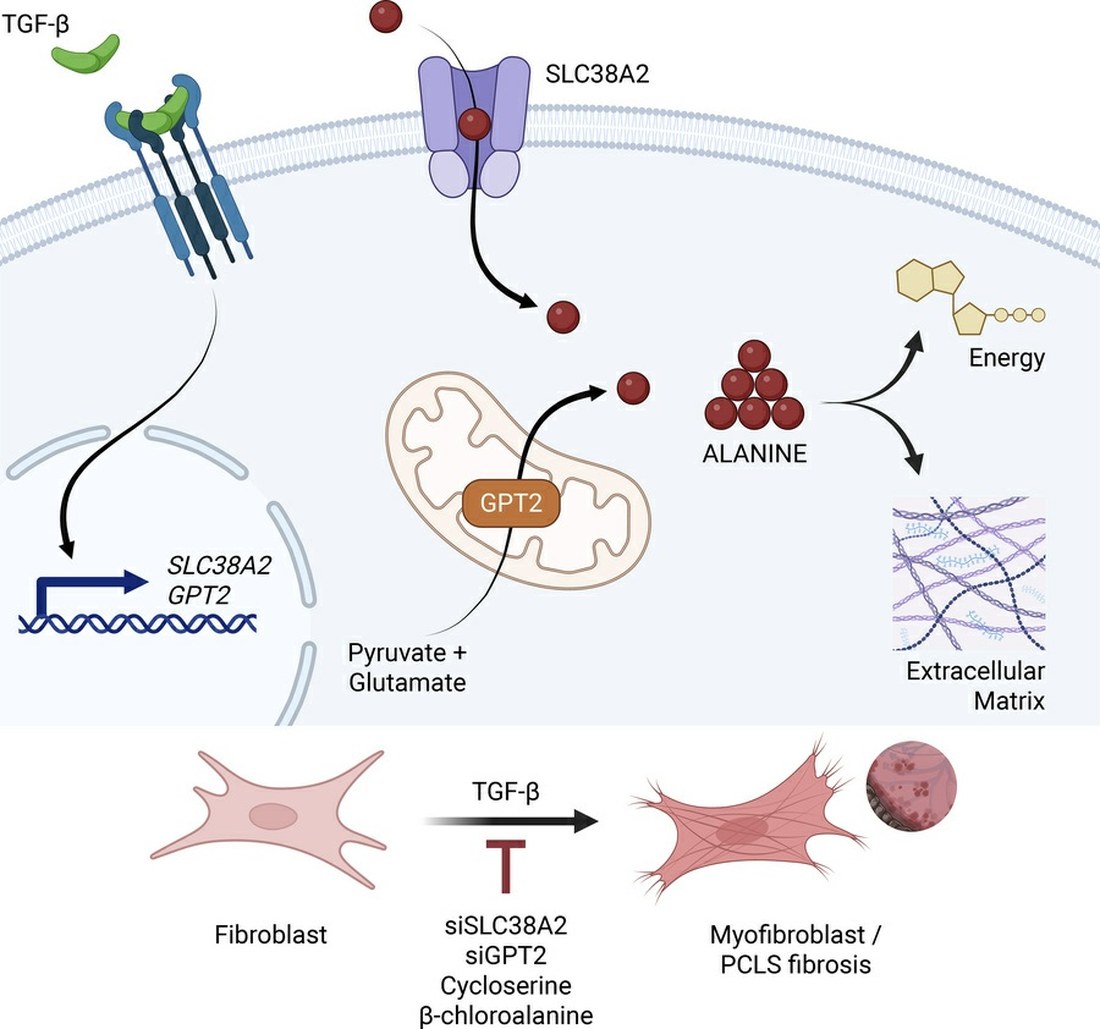
TGF-β raises intracellular alanine through coordinated synthesis and import, supporting matrix production during myofibroblast differentiation.
Answering these questions in tissue rather than in culture requires measurements the field has not previously applied to fibrosis, and much of our current effort is methodological. We culture fibroblasts in human plasma-like medium so that nutrient availability approximates the circulation rather than a general-purpose growth medium. We use scaffold-free three-dimensional microtissues to connect a metabolic perturbation directly to matrix stiffness and collagen organization, which cannot be assessed in two-dimensional culture. We perform whole-animal isotope infusions in fibrotic mice to quantify how much of a circulating substrate is incorporated into lung metabolites and into matrix-bound amino acids. Multi-isotope imaging mass spectrometry then resolves that incorporation spatially, so labeling can be read out in fibrotic regions rather than averaged across the lung.
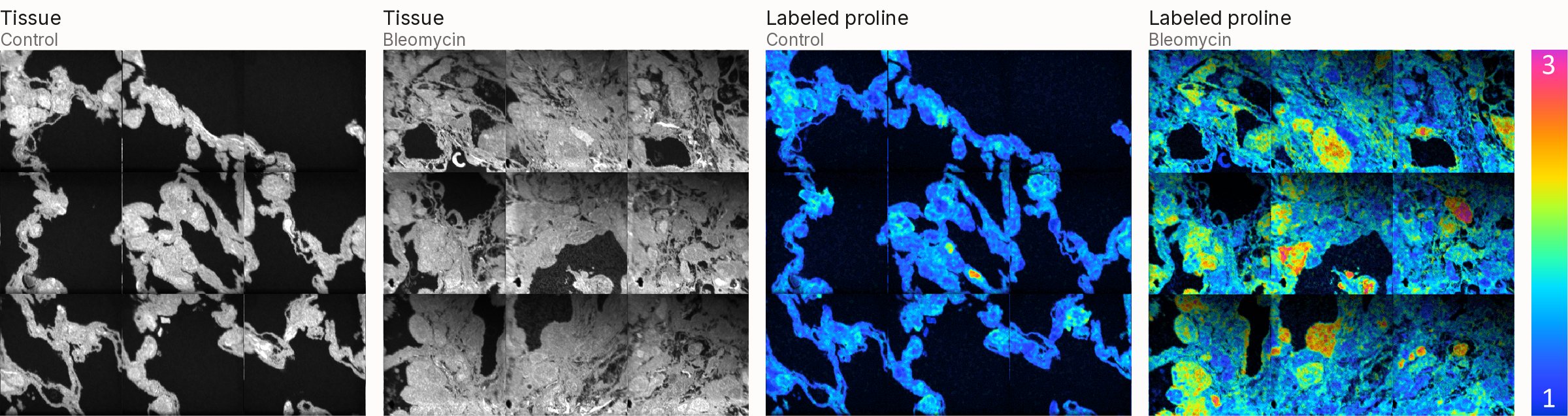
Multi-isotope imaging mass spectrometry of mouse lung after infusion of labeled substrate. Newly synthesized proline accumulates in fibrotic regions.
We are extending these measurements to patients. Building on a pilot study establishing the feasibility of preoperative oral isotope tracing at lung transplantation, we administer labeled alanine to transplant recipients with pulmonary fibrosis and map spatially resolved incorporation in the explanted lung. In parallel, fibroblast-specific Slc38a2 knockout mice will establish whether alanine transport is required for fibrosis in vivo, and whether the benefit of blocking it is attributable to the fibroblast itself. The broader aim is to establish amino acid transporters as a class of antifibrotic target that acts on the substrate supply for matrix production.